Why the northern lights keep showing up over Alta
Alta calls itself the town of the northern lights, and the name rests on more than marketing. It sits at about 70° north, close to where the aurora is seen most often, and its inland weather tends to be steadier than the coast's. The science history goes back to the 1890s.
Under the auroral oval
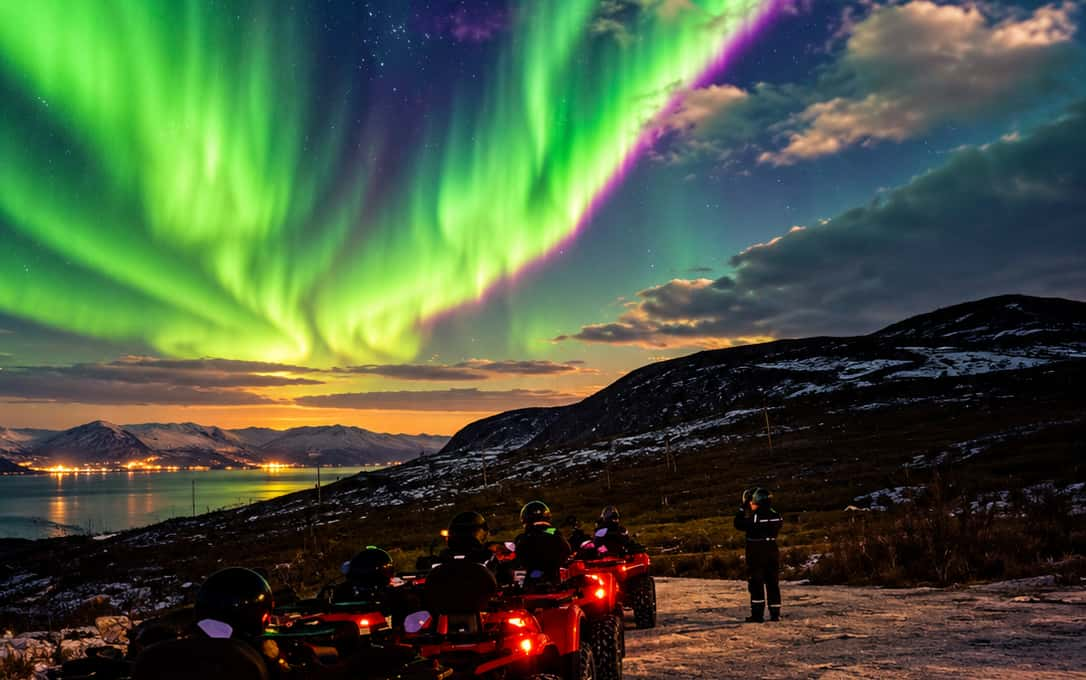
The aurora shows up most often in a ring around the magnetic pole, called the auroral oval. Alta sits at about 70° north, roughly beneath that ring, so the lights can appear right overhead rather than low on the horizon.
Further south the aurora usually sits low in the northern sky, if it shows at all. Over Alta it can spread from one horizon to the other, which is the sight most people travel this far for.
You do not need a strong storm on the sun for a good show here. Even on nights of modest activity the lights over Alta can be bright, which is why cloud cover matters more than the Kp index on most nights.
None of this makes the aurora certain on any given evening. Latitude raises the odds compared with a city further south, and the weather decides the rest. Our forecast guide explains how to read both.
A drier sky than the coast
Alta lies at the head of the Altafjord, the largest town in Finnmark, Norway's northernmost county. Æventyr's listing describes the inland climate as drier and more stable than the outer coast's.
Towns on the open coast get weather straight off the sea, which often brings low cloud and wet snow. Behind the mountains, clear spells often last longer. That is a tendency rather than a promise, and a grey week can happen anywhere in the north.
The other side of a dry inland climate is cold. Away from the fjord, a clear night can reach −20 °C (−4 °F) or colder, and our clothing guide covers what that means for an hour at a roadside stop.
Roads that lead away from the cloud
The practical reason guides like Alta is the road map. Roads run along the fjord and up the river valley inland onto the Finnmarksvidda plateau, and a guide can pick whichever looks clear tonight.
That choice is what a minibus tour sells. Alta Adventure's small-group hunt from ~$257 follows the weather and Kp data and sometimes drives a long way to find a gap. A town with one road out could not offer the same.
Each direction has its own weather. When cloud rolls in from the sea, the inland valley may stay clear, and on other nights the pattern turns around. Guides watch the cloud maps through the afternoon before they decide.
Finnmarksvidda itself is a high, nearly empty plateau, home ground of reindeer herding by the Sámi. Æventyr's snowmobile tour rides to its edge along an old postal road, as our guide to the five kinds of tour describes.
A cathedral named after the lights
The Northern Lights Cathedral opened in 2013 in the center of Alta. Its tower winds upward in a spiral clad in titanium, a shape many visitors read as a nod to the aurora.
It stands in the middle of town, so it fits easily into the afternoon before an evening tour. Check the opening hours locally, since they vary with services and events.
After dark the titanium can catch the street lights and the glow of the sky. If the aurora comes out over town, the tower gives you a landmark in the frame, and our photo guide helps with that shot.
A science history on Haldde
Around 1899 an aurora observatory was built on Haldde mountain near Alta, often described as the first of its kind in the world. It gave this corner of Finnmark an early place in the study of the lights.
Norwegian scientists of that era, Kristian Birkeland among them, worked to explain what the aurora is. Their answer, charged particles from the sun striking the upper atmosphere, is the one guides still give beside the fire.
The Karlsøy tour builds that kind of talk into the evening, with a guide explaining solar wind and the Kp index while the marshmallows roast. It holds 4.8 from 37 reviews on GetYourGuide.
The science of the sky, told by the fire
Amazing Aurora by Karlsøy runs up to six hours with a campfire and free photos of every guest. A big bus, and the lowest fare on this site.
Rock art and short winter days
Alta's other claim is far older. The Alta rock art, thousands of carvings left by Stone Age people, is a UNESCO World Heritage Site and makes a good daylight plan before a night tour.
Daylight is short in midwinter. During the polar night, roughly late November to mid-January, the sun does not rise at all, though a blue twilight lifts around midday. The month-by-month guide explains what that means for your trip.
Getting to Alta
Alta has its own airport with flights from Oslo, so you can reach the town without a long drive across the north. Most aurora tours collect you in the center, and cruise ships call at the harbor.
For guests arriving by sea, the cruise-day guide covers pickups at Alta Havn. For choosing a tour, compare group sizes first, then the fares in the price guide.
Alta is compact, and most hotels sit a short walk or taxi ride from the pickup points. A rental car helps with daytime trips, but leave the night driving on icy roads to the guides.
If you have only a few nights, book the tour early in your stay. That leaves room for a second attempt if the first evening clouds over, which our page on cloudy nights plans for.