Phone and camera settings for Alta's northern lights
A good aurora picture from Alta needs less gear than most people think, but it does need stillness and a few settings you know by heart. This guide covers phones and cameras, the cold-weather problems nobody mentions, and the tours that help you come home with a shot.
Phone or camera?
Recent phones take surprisingly good aurora pictures, as long as they stay still. A camera with manual settings still does better on faint nights, but you do not need one to come home with a picture you will keep.
Whichever you bring, the hard part is the same. You are working in the dark and the cold, often in gloves, so practise the settings at the hotel before the tour leaves.
Getting a sharp phone shot
Switch on night mode and let the phone choose an exposure of a few seconds. Any movement during those seconds smears the stars and the aurora into a blur.
Rest the phone on something steady. A backpack on the snow or a fence post works, and a small phone tripod with a clamp is better still.
Turn off the flash and tap the screen to focus on a bright star or a distant light. For a portrait under the sky, ask your subject to stay still for the whole exposure, which is harder than it sounds in the cold.
Camera settings as a starting point
With a camera, a tripod comes first. After that a wide lens and manual focus do most of the work, and the numbers below get you close on most nights.
- Manual focus set to infinity, tested on a bright star with the screen zoomed in
- A wide lens, around 14–24 mm on a full-frame camera, at its widest aperture
- ISO 1600–3200
- Shutter open for 5–15 seconds, shorter when the aurora moves fast
- Raw files if your camera offers them, for more room to adjust later
- Image stabilization off while the camera sits on a tripod
Treat these numbers as a starting point, not a recipe. Take a test shot and check the screen before adjusting, since a bright, quick aurora wants a shorter exposure than a faint arc low in the north.
Headlamp manners and cold batteries
A headlamp helps you find your bag, but white light spoils everyone's view and photos. Use the red mode, and point it at the ground when other people are shooting.
Cold empties batteries quickly. Keep spares in an inside pocket and swap them as soon as the camera slows, because a warmed battery often comes back to life. Dressing for the stops is covered in our guide to Finnmark night clothing.
When you return to a warm bus or room, a cold camera fogs up inside and out. Put it in a closed bag before you go in and let it warm slowly before you open it.
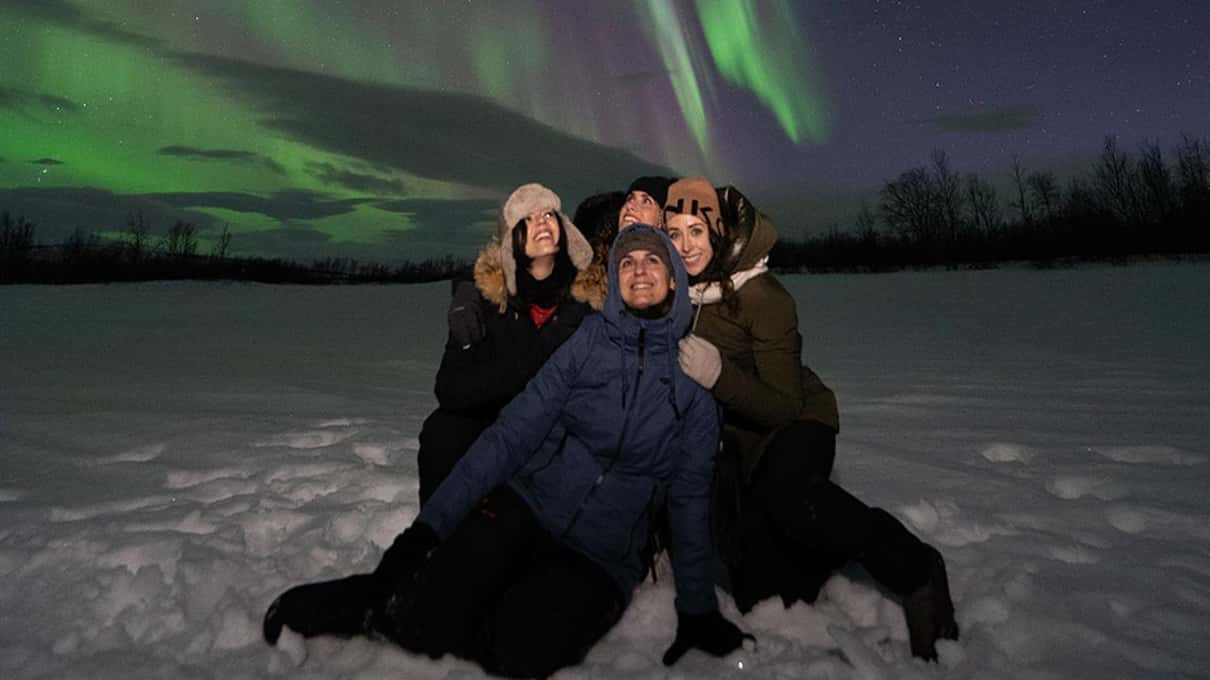
Framing the sky over Alta
A frame of sky alone gets dull quickly. Put a snowy birch or the line of the fjord in the foreground so the aurora has a sense of scale.
Keep the horizon in the lower third and leave room above for the arc to grow. A person standing still with the headlamp off makes a strong silhouette against the green.
Around Alta the stops are often by the fjord or among birch woods on the way inland. Still water can mirror the aurora on calm autumn nights, before the ice comes, so look down as well as up.
Shoot both upright and wide frames while the display lasts. A strong burst can fade within minutes, and you will not get the same sky twice.
Tours that help with pictures
Some tours make photography part of the evening. Karlsøy's aurora night from ~$129 includes free professional photos of every guest under the lights, which solves the problem of getting yourself into the picture.
Alta Adventure's small-group hunt at ~$257 brings camera tripods, and its guides show you how to spot faint lights. GetYourGuide lists the tripods as included, while the Viator listing mentions a rental of about 100 kroner, so check the listing you book.
With up to 13 people at Alta Adventure's stops, there is room to set up a tripod without elbowing anyone. Our guide to small-group hunts explains why that space matters on a dark roadside.
Someone else holds the camera
Amazing Aurora by Karlsøy takes professional pictures of every guest under the lights, free with the fare from ~$129. The night can last up to 6 hours with a campfire and two guides on a big bus. It is on GetYourGuide only, rated 4.8 from 37 reviews.
Shooting from a snowmobile or a quad
A moving machine is no place for a long exposure. On the snowmobile and quad tours you ride with gloves on, and the photos happen at the stops rather than on the move.
A Viator reviewer on Finnmark Adventure's quad hunt from ~$235 describes a stop by the fjord to photograph the lights. Bring a phone or a small camera in a chest pocket rather than a big kit, and see our comparison of tour types for the length of each ride.
Photography help on a big bus
Finnmark Adventure's Northern Lights Bus from ~$149 lists photography assistance among its extras. The catch is the group, since up to 53 guests share that help. Expect a tip or two rather than a lesson.
If the sky stays grey, even good settings will not help. Our guides to reading the Kp index and cloud cover and to nights when clouds win help you plan a second try, because the aurora is never guaranteed.