A low Kp, a clear sky: reading Alta's aurora forecast
Forecast apps make the northern lights look like a number game, and the number most people watch is the Kp index. In Alta that figure matters less than you might expect, and the cloud map matters more. This guide explains what the guides read before they pick a direction, and how you can read it too.
What the Kp number measures
The Kp index is a scale from 0 to 9 that sums up how disturbed Earth's magnetic field is over a three-hour window. Forecast apps show it as a single figure, and it is usually the first thing visitors check.
Low values mean a quiet field, and high values mean a geomagnetic storm that pushes the aurora further toward the equator. The Wikipedia page on the K-index explains how magnetometer readings around the world feed the scale.
For someone watching from southern Norway or Scotland, that number decides almost everything. In Alta it plays a smaller part, and the reason is geography rather than luck.
Why a low Kp is often enough in Alta
Alta lies at about 70° north, at the head of the Altafjord in Finnmark. That places the town roughly beneath the auroral oval, the ring of activity that circles the magnetic pole.
Because the oval already sits overhead, a quiet night with a Kp of 1–3 can still draw an arc of green across the sky above town. A higher value tends to bring brighter, faster displays, but it is not a condition for seeing something.
None of this is a promise. The aurora is never guaranteed on any night or at any Kp, and the 80–90% chance that Alta Adventure's listing claims is the operator's own figure, not a measured rate.
Cloud cover decides most nights
On most evenings the deciding question is whether you can see the sky at all. A strong aurora above a solid layer of cloud stays hidden from the ground, while a modest one under clear air can fill the view.
That is why the guides spend the afternoon on cloud maps rather than solar charts alone. Alta Adventure says it chooses a direction from the weather conditions and the Kp value, and Karlsøy describes its route as following real-time tracking.
Alta helps here. The inland valleys often stay drier and more settled than the outer coast, and roads run off in several directions, so a minibus can leave a cloud bank behind. Our page on why Alta earned its aurora name covers that geography.
Solar wind in plain words
The sun constantly sheds a thin stream of charged particles called the solar wind. When a faster gust of it reaches Earth, the magnetic field steers part of that energy down toward the polar regions.
From around 100 km (60 miles) up the particles strike oxygen and nitrogen in the thin air and make them glow. Oxygen gives the familiar green and, higher still, a deep red. Nitrogen adds pink or violet along the lower edge.
Forecast sites list solar wind speed and the direction of its magnetic field, which can look technical. The guides read those charts for you, and on the Karlsøy bus one of them explains the physics during the night.
What your eyes see, and what the camera sees
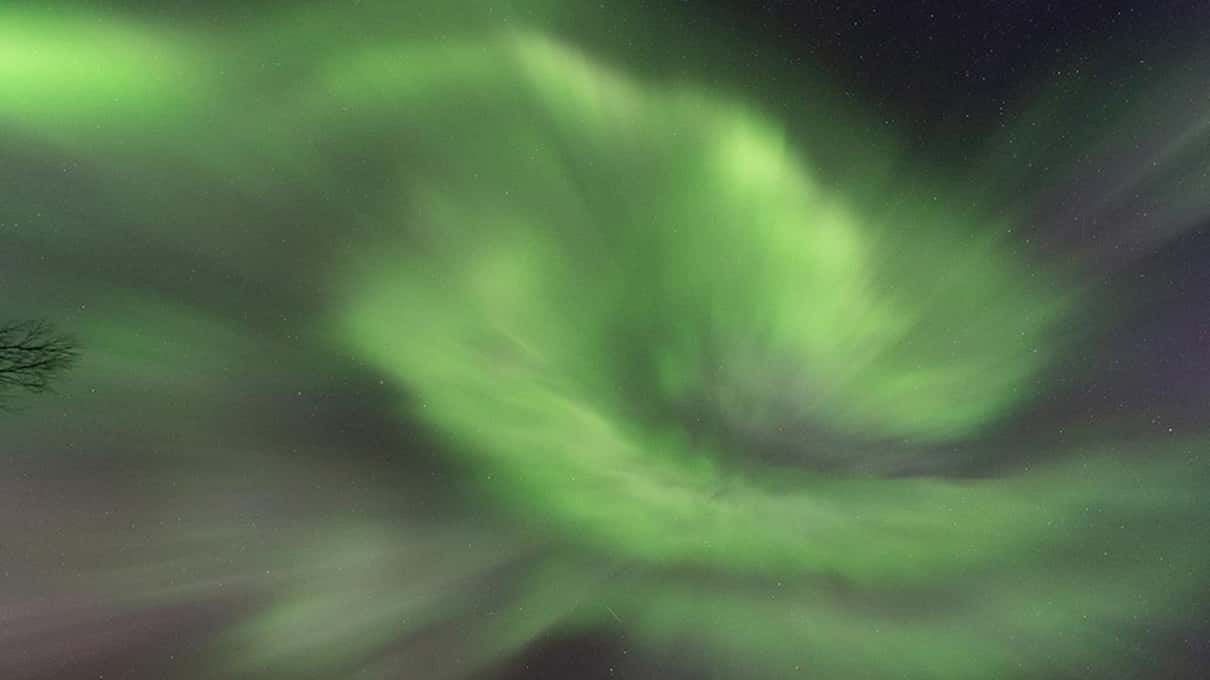
Many first-timers are surprised by the color. A faint aurora often looks greyish white or pale green to the naked eye, because human night vision picks up very little color in the dark.
A camera gathers light for several seconds and records the green far more strongly. Alta Adventure's listing says the same, noting that photos often show stronger colors than you see yourself. Our guide to photographing the aurora in Alta covers the settings.
So when a guide points at what looks like a thin, pale cloud, take a test shot before you dismiss it. On a strong night the colors are obvious to everyone, but those nights arrive on their own schedule.
A clear sky over the plateau
When the cloud map shows clear high ground, Æventyr's snowmobile night follows the old postal road toward Beskardes on the edge of Finnmarksvidda. You drive your own machine for about two hours of a 4-hour evening, from ~$284. It stays in that area, so it cannot chase a gap elsewhere.
The hours to watch
The darkest part of the night gives the best chance, and in Alta that often means roughly 9 pm to 1 am. Activity can come earlier or later, and some of the brightest bursts last only a few minutes.
That is why most tours here leave in the evening and come back around midnight. Alta Adventure returns guests to the town center normally just after midnight, while the Karlsøy bus can stay out for up to 6 hours.
In the light months there is nothing to see at all, whatever the forecast says. Our month-by-month guide to Alta's season explains when the nights turn dark enough to start looking.
Using a forecast as a visitor
You do not need to learn the charts in depth. A few habits get you most of the benefit and save you from cancelling a good night over a low number.
- Check the cloud forecast for the Alta area on the afternoon of your tour, not days ahead
- Treat a high Kp as a bonus; a low one is no reason to stay in
- Book early in your stay, so a cloudy first night leaves room for another try
- Dress for long stops, as our guide to dressing for Finnmark nights explains
- Let the guide choose the direction, since they read the same maps every evening
If the forecast shows thick cloud everywhere, most tours still go out. What happens on those evenings is covered in when clouds hide the lights over Alta.
Tours that can follow a gap in the clouds
A tour that drives has the most room to respond to the forecast. Alta Adventure's small-group minibus hunt from ~$257 heads wherever the sky looks clearest, sometimes far, with a group of up to 13.
Karlsøy's big bus follows its own tracking at ~$129 with a campfire and free photos. The activity tours stay in one area, which suits a clear night better than a doubtful one, as our comparison of tour types shows.
Finnmark Adventure's Northern Lights Bus from ~$149 also has no fixed route and a guide who watches the sky. The catch is size, with up to 53 people on a heated bus that may not reach the smaller back roads a minibus can use.